
1. Executive Summary
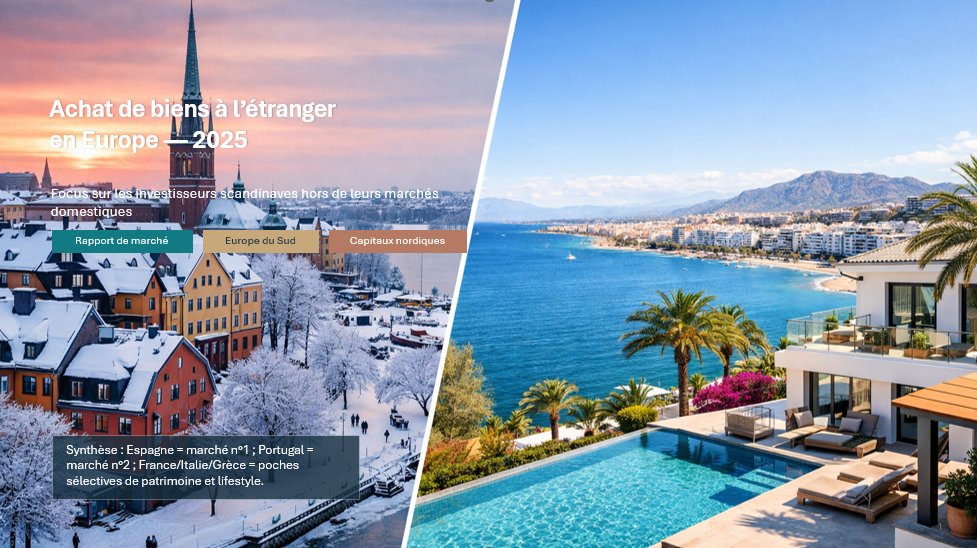
In 2025, the European cross-border real estate market rebounded after the slump of 2023. This recovery was driven by three factors: the gradual reduction of ECB interest rates, the return of international demand in lifestyle residential markets, and the search for tangible assets in a still uncertain environment. Within this trend, Spain remained the most significant destination for Nordic buyers, followed by Portugal, and then a more fragmented group comprising France, Italy, and Greece.
The key point for an investor or market operator is this: Scandinavians are not just buying sunshine. They are also buying legal stability, air connectivity, a higher quality of life in winter, and markets where their real estate purchasing power remains favorable compared to Copenhagen, Stockholm, Oslo, or certain tight markets in their domestic markets.
2. Macroeconomic Context 2025 in Europe
The European environment became more favorable for property purchases in 2025. The ECB lowered its key interest rates in March 2025, bringing the deposit rate down to 2.50% as of March 12, 2025. At the same time, the average cost of home loans in the euro area stabilized in spring 2025, with a composite mortgage rate of around 3.5% to 3.9%, depending on the maturity.
On the price front, the European residential market rebounded. Eurostat reports that in Q1 2025, house prices rose by 5.4% year-on-year in the euro area and by 5.7% in the EU. In Q3 2025, the increase reached 5.1% in the euro area and 5.5% in the EU. The market is therefore no longer experiencing a generalized correction, but rather a phase of selective recovery, stronger in markets with low supply and high international demand.
In terms of investment flows, Savills projects approximately €214 to €215 billion in real estate investment in Europe by 2025, a year-on-year increase, with growing support from cross-border activity. CBRE also notes that the "living" segment has become the primary target for cross-border real estate investors in Europe, according to its 2025 survey. While this mainly concerns commercial investment, it confirms the renewed appetite for European residential properties.
3. Size and Structure of the European Market for Buying Property Abroad
There is no single, uniform pan-European figure for residential purchases by foreign individuals. However, the most readily observable markets show that the segment remains significant, particularly in the southern region. Spain is the best indicator. According to registrars, foreign buyers have represented around 14% to 15% of the Spanish market recently, a level that remains consistently high compared to the long-term average. Preliminary data for 2025 indicates nearly 97,300 purchases by foreigners, a record, out of more than 705,000 total sales.
Portugal remains a highly sought-after market, but with less public transparency regarding the breakdown of residential buyers by nationality. Prices there have nevertheless accelerated sharply: Statistics Portugal indicates that in Q3 2025, the median price of homes sold reached €2,111/m², a 15.8% year-on-year increase. Portugal therefore remains a highly internationalized market, but one that is tighter and more expensive than it was a few years ago.
4. Why Scandinavians are investing outside their countries
The driving force is not solely tax-related. It is primarily climate-related, related to heritage, and generational.
In Sweden, the OECD notes that the market has experienced significant supply and demand pressures, coupled with imperfect housing policies. Finance Sweden observes that after the sharp decline in 2022-2023, prices rebounded slightly in 2024-2025 thanks to lower interest rates. In short: the domestic market is not "broken," but it remains expensive and structurally constrained in desirable areas.
In Norway, Eiendom Norge reports that prices rose by 5% in 2025, with an average price of approximately NOK 4.42 million at the end of 2025. This reinforces the appeal of residential or semi-wealth diversification abroad.
In Denmark, the Danish National Bank describes a "two-speed" market in 2025, with significant pressure around Copenhagen. The OECD emphasizes in early 2026 that housing costs there are high and that imbalances are particularly pronounced in the capital. In practice, for an affluent or upper-middle-class Nordic household, buying property in Spain or Portugal is driven by five main reasons:
personal and semi-residential use,
asset diversification outside the domestic market,
retirement/pre-retirement purchase,
climate-related investment and remote work considerations,
seeking seasonal or mixed rental income.
This rationale aligns with the analysis by CaixaBank Research, which highlights the strength of Northern European demand for Spanish residential real estate.
5. Focus: Where will Scandinavian capital go in 2025?
Spain: Market number 1
This is by far the best-documented and most important market for Scandinavians. Registrar statistics show that in Spain, Swedes represent a significant share of foreign buyers, ahead of Norwegians and Danes. Already at the end of 2023, Sweden accounted for 5.24% of foreign purchases, Norway 1.33%, and Denmark 1.18%. These nationalities remain structurally present among the top foreign buyers.
The 2025 profile is particularly interesting: foreigners are still buying heavily in Spain, and Scandinavians are among those paying the highest prices per square meter. In 2025, average prices paid by foreign buyers reached a record high of approximately €2,417/m², with Swedes at around €3,421/m² and Norwegians at around €3,292/m² among the most sought-after nationalities. This means that while Nordic buyers are relatively few in number compared to the British or Germans, they are highly affluent and focused on higher-quality properties.
The most relevant areas for this demand are:
Costa del Sol: Marbella, Estepona, Mijas, Fuengirola, Benahavís;
Costa Blanca: primarily Alicante and its surrounding areas;
Balearic Islands: a more premium, highly international market;
and to a lesser extent, Valencia and certain areas of Catalonia.
Portugal: Market Number 2
Portugal remains very attractive to Scandinavians, especially Lisbon, Cascais, Comporta, the Algarve, and certain premium lifestyle segments. However, the market has become more expensive, more selective, and less tied to a residential investment model than before. Prices accelerated sharply in 2025, and the country eliminated the Golden Visa real estate pathway in 2023, shifting the market towards genuine residential buyers, whether for investment or rental purposes, rather than those primarily motivated by the desire to own a residence.
For Scandinavians, Portugal remains attractive for three reasons: quality of life, legal security, and a more premium residential image than a purely beach resort. On the other hand, rising prices reduce its competitive advantage compared to certain Spanish areas.
France: High-End Niche Market
France tends to attract Scandinavians to specific segments: the Alps, Provence, the French Riviera, and sometimes prime Paris. This is not a volume market for them, but rather a market for heritage properties, safe havens, and premium second homes. Signals for 2025-2026 indicate a resurgence of international interest, including from Northern Europe, particularly in mountain residences and high-end destinations.
Italy: A market of heritage opportunity
Italy attracts Nordic buyers primarily for Tuscany, the lakes, Liguria, Sardinia, and certain historic cities. The investment thesis is based less on the speed of appreciation than on the quality of the heritage properties, their scarcity, and sometimes entry points that are still lower than those of premium France or Portugal. Consolidated public data by nationality is less readily available, but market signals indicate a transformation in foreign demand in 2025.
Greece: Growing, but more speculative
Greece is attracting increasing numbers of foreign buyers in 2025, particularly to the coast, the islands, and Athens. For Scandinavians, the argument is clear: climate, still competitive prices in some markets, and tourist rental potential. However, it is a more heterogeneous market, more dependent on tourism, and, depending on the area, riskier in terms of execution than Spain.
6. Profile of Scandinavian Buyers
The dominant profile in 2025 is not that of the pure speculator. Instead, we observe:
individuals aged 50-70 preparing for semi-retirement or seasonal residences;
high-net-worth individuals able to purchase with little or no local debt;
a preference for turnkey properties that are energy-efficient, well-connected, and close to the airport and services;
a strong preference for safe and transparent markets, even at higher prices.
The Spanish case also shows that foreigners, structurally, make less use of local credit than Spaniards. CaixaBank Research noted that in 2022 only 34% of foreign buyers took out a loan in Spain, compared to approximately 78% of Spanish buyers. This reinforces the idea that Nordic clients have high savings capacity and are therefore resilient to interest rate cycles.
7. Decisive Purchasing Factors for Scandinavians
The most important criteria in 2025 are:
1. Climate and Long-Season Use
The desired market is no longer solely focused on summer. A destination that can be enjoyed from autumn to spring is essential. Southern Spain and Portugal maintain a clear advantage.
2. Air Accessibility
The frequency of direct flights to Stockholm, Copenhagen, Oslo, Gothenburg, or Bergen is a significant factor in determining value.
3. Legal Security and Transaction Quality
Spain and Portugal remain well-positioned for European buyers seeking a secure framework, notaries, registries, and predictable execution.
4. Rental Resilience
Buyers often want a property that can be used as their primary residence but also rented out for part of the year.
5. Energy Efficiency
This is particularly important for Nordic buyers, who are sensitive to building performance and operating costs. It is becoming a key selection criterion, not just a bonus. 8. Risks and Obstacles in 2025
The market remains buoyant, but there are clear risks.
In Spain, the abolition of the Golden Visa for real estate has been in effect since April 3, 2025. For Scandinavian EU citizens, this is not a major issue, but for Norwegians, who are not in the EU, the regulatory environment warrants closer attention. There was also a political proposal in 2025 to impose a 100% tax on real estate purchases by non-EU residents, but it was not in effect at the time the sources consulted were released and remained subject to an uncertain parliamentary process.
In Portugal, the main obstacle has become the price level in the most sought-after areas. It is no longer a “cheap” market; it is a premium market with more scarce and competitive properties.
Throughout Southern Europe, the following must be added:
risk of stricter short-term rental regulations,
local pressure on access to housing,
renovation costs and ESG requirements,
climate risks in certain coastal areas or fire-prone regions.
9. Competitive analysis: which countries will truly win in 2025?
Net winners
Spain: greater market depth, better statistical visibility, strong foreign demand, wide supply, very good fit with Scandinavian countries.
Portugal: premium market, strong appreciation, very strong international image, but less accessible than before.
Selective winners
France: very good for high-end and mountain properties, less so for accessible returns.
Italy: strong emotional and heritage value, but a more fragmented market.
Greece: good potential, but more cyclical and more uneven across different areas. 10. What this means for a market player
If your goal is to enter this market, the most robust conclusion is as follows:
The core of Scandinavian demand in Europe in 2025 is Spanish.
Swedish clients are the most visible and creditworthy among Scandinavians, according to available market data.
Norwegians remain important, but face slightly higher regulatory risk in Spain due to their non-EU status.
Danes are less prominent in terms of volume, but belong to the same segment of high-quality demand.
Portugal is the second most natural market, but more expensive and more selective.
France, Italy, and Greece are primarily niche markets or markets for wealth arbitrage, not the main Nordic mass markets.
11. Strategic Recommendations
For a developer, agency network, wealth management firm, proptech company, or family office, I would recommend the following in 2025:
Geographic Positioning
Prioritize the Costa del Sol, Costa Blanca, Balearic Islands, then the Algarve/Cascais-Lisbon.
Product Positioning
Focus on:
"lock-up-and-leave" apartments and villas,
new or renovated properties,
very good energy ratings,
proximity to airports, healthcare facilities, shops, golf courses, and the sea,
structured rental management.
Marketing Positioning
The most effective promise for Scandinavians is not "maximum return," but rather:
personal use + supplemental income,
security + simplicity,
quality of life in winter,
preservation of value.
Point of Attention
For Norwegian clients, integrate country-by-country regulatory monitoring, especially in Spain.
Conclusion
By 2025, the European market for buying property abroad had regained its dynamism, but it remained highly polarized. For Scandinavians, the dominant strategy was international residential real estate for comfort and portfolio diversification, rather than pure speculation. Spain was the big winner, with strong and visible demand from Nordic countries, particularly Sweden. Portugal followed as a premium market. France, Italy, and Greece played complementary, more niche roles.